
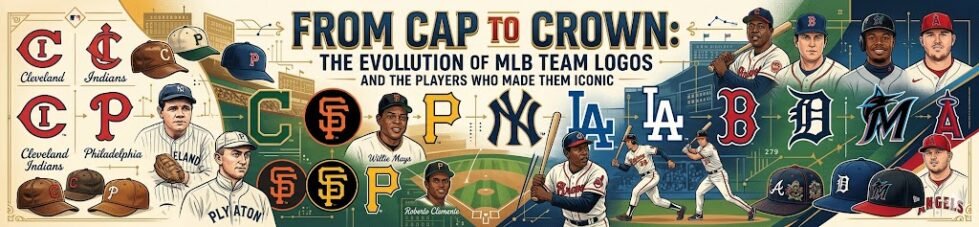
A baseball cap is one of the most distinctive pieces of visual design in American sports. The interlocking NY of the Yankees, the swinging A of the Athletics, the Old English D of the Tigers, these marks have outlasted players, managers, owners, and even cities. They carry the weight of eras, serving simultaneously as civic symbols, fashion artifacts, and shorthand for entire chapters of the sport’s history. Understanding how they evolved, and which MLB players gave them their deepest meaning, is to understand how baseball works as a cultural institution. The evolution of MLB Team Logos reflects this rich heritage.
The Icons That Never Change
Each MLB Team Logo serves as a reminder of the past and a beacon for the future.
The Yankees’ interlocking NY monogram was not originally designed for a baseball team. It was first created in 1877 as part of a medal for NYPD bravery, adopted by the team in the early 1900s, and has remained virtually untouched ever since. That kind of design longevity creates something beyond branding; it creates a vessel for memory. Joe DiMaggio wore it while hitting in 56 consecutive games in 1941.
Mickey Mantle wore it through 536 home runs and seven World Series championships. Derek Jeter wore it through five championships and 3,465 career hits before retiring in 2014 with the interlocking letters still meaning exactly what they meant in 1927. The Dodgers’ iconic LA script, used in Los Angeles since 1958 and by the Brooklyn Dodgers from 1945 to 1957, carries a parallel weight. Sandy Koufax defined one era of that mark, going 25-5 with a 2.04 ERA in 1963 and winning three Cy Young Awards in four seasons.
Clayton Kershaw extended it across the next half-century, accumulating 213 career wins in Dodger blue before retiring. The Cardinals’ birds-on-bat logo, which debuted in 1922 and was inspired by Branch Rickey and local church decorations, has remained virtually unchanged for over 100 years, making it one of the most consistent visual identities in professional sports.
The Detroit Tigers have used some version of the Old English D since 1904, with the current version becoming the uniform primary mark in 2016, marking the first time the franchise had a completely consistent look across all uniform elements in nearly 100 years.
The Franchises That Constantly Evolve
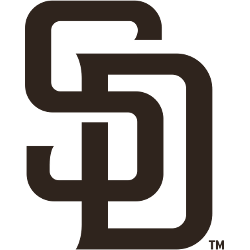
Not every MLB organization treats its logo as sacred. The San Diego Padres have cycled through brown-and-yellow, then navy, then brown again, with each shift corresponding to a distinct player era and organizational philosophy.
Tony Gwynn spent his entire 20-year career with the Padres in the brown-and-yellow and early navy eras, winning eight batting titles and finishing with a .338 career average. Fernando Tatís Jr. returned the franchise to its current brown identity in an era defined by youth, energy, and a willingness to show personality.
The Houston Astros made one of the most dramatic visual transformations in baseball history, moving from the rainbow-striped tequila sunrise uniforms of the Biggio and Bagwell era through a navy-and-orange palette before settling on their current Lone Star-influenced identity.
Craig Biggio and Jeff Bagwell were both inducted into the Hall of Fame, their careers permanently associated with one visual register of that franchise. Jose Altuve and Yordan Alvarez operate in a completely different one.
The Brewers’ beloved ball-in-glove logo, which cleverly hides the letters M and B in the negative space of a glove catching a baseball, has been brought back multiple times as an alternate mark after its original retirement, reflecting the kind of fan attachment that makes visual conservatism a commercial asset even for franchises that experiment with identity.
Major Rebrands and What They Cost
The Cleveland Indians-to-Cleveland Guardians transition in 2022 is the most significant MLB rebrand of the modern era. The new logo features a stylized G with wings, directly inspired by the Guardian of Traffic sculptures on Cleveland’s Hope Memorial Bridge, which flanks the ballpark.
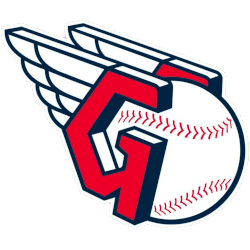
The transition required retiring Chief Wahoo, a mascot that had been contested for decades, and rebuilding a fan community’s visual relationship with its team from scratch. The rebranding cost the franchise an estimated $19 million in merchandise replacement and rebranding infrastructure across all platforms.
The Oakland Athletics’ move first to Sacramento for the 2025 season and eventually to Las Vegas presents a different kind of visual disruption: a logo whose entire civic meaning is in transition. The green-and-gold identity, established when the franchise moved from Kansas City to Oakland in 1968, now must carry the weight of displacement as a new permanent identity is constructed around a market with no historical relationship to those colors.
When a city changes, the logo does not automatically update; it carries the history of the previous place as dead weight or as heritage, depending on how the transition is handled.
Where Today’s Players Sit in This Visual History
For fans tracing how a team’s identity carried through specific eras, today’s MLB rankings provide a useful counterpart: the players currently wearing those logos are the ones whose careers will define the next chapter in the visual history of each franchise.
Aaron Judge has already surpassed the single-season American League home run record, hitting 62 in 2022 to break Roger Maris’s mark of 61, and has signed a nine-year, $360 million contract that will keep him in pinstripes through at least 2031. The interlocking NY will mean something specific about the Judge era, as it did about the Jeter era, and the Mantle era before that.
Shohei Ohtani signed a 10-year, $700 million contract with the Los Angeles Dodgers, the largest contract in professional sports history, beginning in 2024. His career will be permanently associated with the LA script in the way Koufax and Kershaw’s careers were, adding a third defining chapter to one of baseball’s most stable visual identities. Bobby Witt Jr., who signed an 11-year, $288 million extension with the Kansas City Royals in 2023, is building a relationship with the Royals’ crown-and-shield identity that could last well into the 2030s.
Cap Culture Beyond the Field
MLB caps became mainstream fashion items in the late 1980s and early 1990s, when hip-hop artists began wearing fitted caps from teams with which they had no geographic ties. The New Era 59FIFTY cap, which became the official on-field cap for all MLB teams in 1992, turned a piece of game-worn equipment into one of the most versatile fashion accessories in American streetwear.
The Yankees’ NY, Cardinals’ STL, and Dodgers’ LA became global fashion marks worn by people who had never seen a live baseball game.
Today, MLB generates over $4 billion annually in licensed merchandise, with caps accounting for a significant portion of that total, and team rebrand cycles are now explicitly factored into merchandise demand. The Padres’ return to brown generated a documented spike in jersey and cap sales, and the Guardians’ new identity sold out its initial merchandise run within 48 hours of announcement.
A logo on a cap is a contract between a city, a team, and the fans who wear it, and every era of players renews that contract. The ones swinging the bat right now are writing the next chapter.