
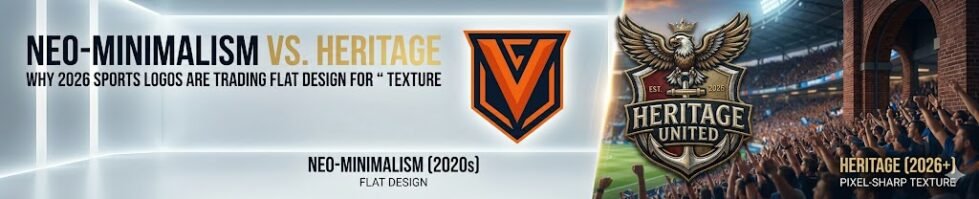
For the best part of a decade, the dominant grammar of sports logo design was silence. Clubs flattened their crests, stripped embossing from their badges, and deleted the shadows that gave their shields a sense of weight. The lion became an outline. The crest became a glyph. The colours became brand tokens. It was a logical response to the digital era - logos needed to work at 16×16 pixels on a phone notification, not stitched across a felt pennant - but something was quietly lost in translation.
In 2026, the pendulum has swung. Across European football, North American sports franchises, and the increasingly design-conscious world of Irish club sport, a new visual language is emerging. Designers are calling it different things - pixel-sharp texture, neo-heritage, tactile minimalism - but the impulse is consistent: bring the grain back. Put the depth back in. Make the badge feel like it weighs something again, even at thumbnail size.
This is not nostalgia for its own sake. The movement is technically sophisticated, philosophically coherent, and driven by a generation of designers who grew up on flat design and have consciously decided to push beyond it.
The Flat Design Era and Its Discontents
To understand what is being rejected, it helps to trace how the minimalist consensus formed. The late 2000s and early 2010s brought a wave of corporate rebranding that prioritised scalability and legibility above all else. Skeuomorphism - the design philosophy that made digital objects mimic physical textures - collapsed almost overnight. Apple led the charge, Google followed, and the logic filtered down into sport.
Some rebrandings were genuinely successful. Many were not. The backlash to Juventus's 2017 rebrand - replacing a century of heraldic tradition with a geometric monogram that could have belonged to a Danish furniture brand - became a cultural flashpoint in design criticism. It worked as a luxury mark but failed as a football club mark. It communicated aspiration but not belonging. Supporters didn't tattoo it on their forearms.
The crisis was long in coming. By the mid-2020s, a recognisable aesthetic fatigue had set in. Fans mocked the sameness. Certain Premier League rebrand attempts became memes within hours. The creative conversation shifted: what would it look like, designers asked, to build a badge that was both digitally legible and visually textured? Could you have the crispness of flat design at small sizes while restoring depth, shadow, and grain at full scale?
The answer, it turns out, is yes - and the technology to do it has only recently matured.
What 'Pixel-Sharp Texture' Actually Means
The term is something of a designer's shorthand, but it describes a precise technical achievement. Pixel-sharp texture refers to the application of fine-grain detail - hatching, embossing, fabric weave simulation, metallic sheen, even subtle noise layers - that is rendered at vector precision. It doesn't blur on a Retina display. It doesn't pixelate on a billboard. It reads as clean at a distance but rewards close inspection with depth.
The key enabling technologies are advances in variable font rendering, higher-fidelity SVG gradient meshes, and - critically - the wider adoption of adaptive logo systems that serve different versions of the same mark at different scales. A club can now maintain a flat, pure-colour icon for app notifications and simultaneously deploy a full-texture master mark for broadcast, merchandise, and stadium signage. The two are the same design - but the master breathes.
This solves the false dilemma that drove so many of the flat rebrands: the assumption that you had to choose between digital utility and visual richness. You no longer do.
European Football Leading the Charge
It is across European football - where badge culture runs deepest and supporter investment in visual identity is highest - that the neo-heritage movement has produced its most interesting results.
Germany: The Bundesliga's Textural Turn
German football has long balanced commercial modernity with working-class identity. The Bundesliga's own brand guidelines were quietly updated ahead of the 2025–26 season to accommodate what internal documents describe as "material authenticity" - a directive that has filtered down to several clubs reviewing their visual identities. Borussia Dortmund, whose bumblebee yellow has been one of European sport's most recognisable colour stories, refreshed secondary badge elements with subtle cross-hatching on shield edges, restoring a sense of forged metal to what had been a near-sterile geometric lockup. It is a small change. It reads as enormous.
FC Bayern Munich's centenary sub-marks, used across 2025–26 season collateral, leaned into wool-thread texturing on the traditional roundel, explicitly evoking the tactile quality of vintage embroidered badges. The effect is simultaneously retro and razor-sharp - exactly the neo-heritage paradox the movement is built on.
Spain: Atlético Madrid and the Return of the Woven Crest
Atlético Madrid have always occupied a particular cultural space in European football - the working-class counterweight to the Bernabéu's glamour - and their visual identity has historically reflected that defiant character. A 2025 badge refinement, largely underpublicised, introduced micro-texture on the bear-and-strawberry-tree illustration at the crest's centre. The illustration now carries subtle ink-on-paper grain that makes it read less like a vector clip and more like a hand-drawn etching. Supporters noticed immediately. The reaction was overwhelmingly positive: it looks like something you'd find in the club museum.
Netherlands: Ajax and the Art of Restraint
Few clubs have as rigorous a design culture as Ajax. Their famous Louis van Gaal–era modernisations established a template of the near-Bauhaus economy. But a quiet revision to the Ajax wordmark and secondary marks in 2025 introduced a fractional stroke weight variation and a subtle paper-print texture on certain heritage applications. It is the most minimal expression of the pixel-sharp texture movement - almost invisible - but it represents something philosophically significant from a club that has always treated visual identity as a serious discipline.
Borussia DortmundCross-hatch detailing on shield edges reintroduces a forged-metal quality to the primary badge while retaining flat-colour legibility at small sizes. |
FC Bayern MunichCentenary sub-marks deploy wool-thread texture on the classic roundel, bridging vintage embroidery aesthetics with contemporary SVG rendering. |
Atlético MadridInk-on-paper grain applied to the bear-and-madroño illustration gives the crest the quality of a hand-drawn etching rather than a vector object. |
AjaxRestrained paper-print texture on heritage applications - barely visible, philosophically significant from a club with Bauhaus-level design rigour. |
The Irish Dimension: Identity Under Pressure
The conversation about logo texture and heritage carries a particular charge in Ireland, where the relationship between sporting identity and cultural history is rarely straightforward. Irish clubs and governing bodies are navigating the same global design pressures as their European counterparts - the pull toward clean, scalable, sponsor-friendly minimalism - but with an additional layer of significance attached to the symbols they use.
The League of Ireland has undergone a visibility renaissance in recent years, driven partly by the explosion of online fan communities and the rising profile of domestic football on streaming platforms. With that visibility has come intensified scrutiny of club branding. Several clubs have found themselves caught in the flat-design trap: rebrandings that tested well in focus groups and looked professional on a website banner but felt hollow to supporters who had grown up with older, more ornate crests.

Bohemian FC in Dublin have taken an increasingly bold approach to visual storytelling, extending their burgundy-and-black palette into rich, textured merchandise and matchday print design that feels closer to the zine-culture aesthetic of European ultras than to corporate sports branding. It is a conscious philosophy, and it resonates deeply with their urban supporter base.
The GAA - Gaelic Athletic Association - presents its own fascinating case study. County crests across hurling and football have largely resisted the minimalist wave, retaining intricate heraldry that dates back generations. If anything, the GAA's resistance to flat design now looks prescient. County boards that quietly modernised their visual identities in the 2010s have in several cases been pushed by supporters to restore earlier, more detailed versions. Kerry's gold-and-green, Kilkenny's black-and-amber, Galway's maroon - these are not just team colours but chromatic dialects, and the badges that carry them need to feel weighty enough to hold the meaning they're asked to bear.
For those engaging with Irish sport as fans, bettors, or broadcasters, platforms that take visual identity seriously set themselves apart. NetBet Sport is among those that have invested in presenting Irish sport - from League of Ireland fixtures to GAA coverage - within a design environment that respects the visual culture of the competitions it covers, rather than flattening them into generic tiles.
The Technology Making It Possible
It would be misleading to present the neo-heritage movement as purely a philosophical reaction to aesthetic fatigue. It is also a technology story. Three developments have made pixel-sharp texture viable at scale in a way it simply wasn't a decade ago.
First, the maturation of adaptive SVG systems. Modern vector tooling - particularly Figma's component logic and Adobe Illustrator's variable export pipelines - allows designers to build a single source file that generates multiple expressions of a mark: a clean single-colour version for small-screen applications, a full-texture master for print and broadcast, and several intermediate states for digital display. The old dilemma of choosing between detail and utility no longer applies.
Second, the rise of high-refresh, high-resolution screens as the norm rather than the exception. A texture that looked muddy on a 72dpi web display in 2012 renders with precision on a modern OLED panel. The visual environment has caught up to what designers wanted to do.
Third, and perhaps most importantly: the tactile merchandise renaissance. The explosion of premium sportswear culture - the cult of the retro kit, the heritage jersey, the limited-edition embroidered patch - has created a market in which fans actively want badges that look like they belong on a physical object. A flat digital mark cannot anchor a £150 embroidered scarf the way a textured, three-dimensional crest can. Clubs have noticed. Designers have responded.
What Comes Next: Heritage as a Design Language, Not a Safety Blanket
There is a real danger in the neo-heritage movement, and it is worth naming. Texture can become pastiche. The search for authenticity can produce kitsch - a laboratory simulation of history rather than the real thing. The best work in this space succeeds because it is rooted in a specific club's actual visual history: the particular shade of blue on a 1960s enamel badge, the specific serif used on a programme cover from the club's founding decade, the way a crest was hand-stitched on a captain's blazer for a cup final that happened before anyone alive today was born.
When designers go hunting in the archives - and the best of them do - the results are transformative. When they apply a generic grain filter and call it heritage, the results are worse than the flat design they replaced.
The clubs getting this right in 2026 are those that have invested in their own visual histories: digitising old programmes, photographing original embroidered badges, commissioning typographic archaeology that traces how their wordmark has evolved across a century of use. That investment is not just preservationist. It is a design resource - raw material for a mark that carries genuine weight because it actually comes from somewhere.
In Ireland, where sporting history intersects with national history at almost every turn, that archaeological approach to badge design feels not just creatively appropriate but culturally necessary. A League of Ireland crest is not merely a commercial mark. It is a document. How it is designed - whether it has grain, whether it has depth, whether it feels like it has been somewhere - matters in ways that extend well beyond brand strategy.
The flat design era asked: how simple can this be? The pixel-sharp texture movement is asking a better question: how much can this hold?