
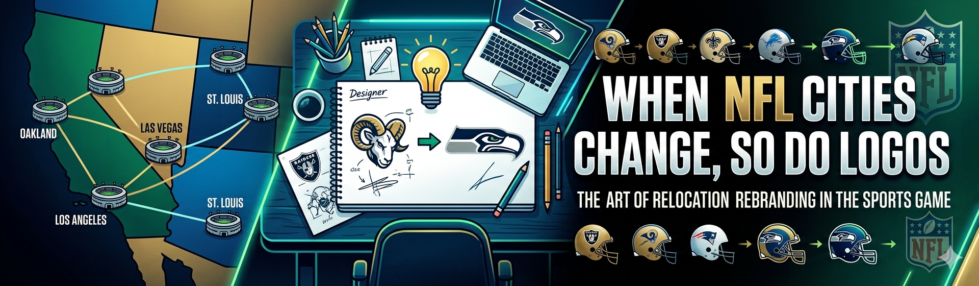
Relocation in the NFL is never only a map change; it is a public redesign of memory, loyalty, and merchandise. A team leaving one city has to explain itself before fans buy a new cap, and that explanation often starts with a logo. Even outside football, brand signals teach audiences where to look: a live dealer review from a casino Iceland expert choice can sit beside online slots and use trust and motion as a helmet mark does. When a franchise arrives, the new identity must feel native quickly, yet not erase the sporting lineage television viewers recognize. The NFL’s best relocation rebrands resolve that tension through color, myth, and a single clean shape. As NFL Cities Change, the visual identity of a team evolves to capture the spirit of its new home.
The Helmet as a Moving Address
A relocated NFL logo works like a street sign at full speed. It has to announce the new home from the upper deck, on score bugs, in fantasy apps, and across social feeds where attention lasts a blink. That is why relocation rebranding rarely rewards illustration alone. A detailed mascot may look handsome on a poster, but it can collapse into noise when shrunk onto a helmet stripe. City moves also change the emotional brief. St. Louis Rams nostalgia was not the same as Los Angeles Rams sunshine, celebrity, and Pacific horizon. The mark had to bend toward light, speed, and spectacle while keeping horns that older fans could identify. That balance is the whole craft: change enough to justify the move, but preserve enough to prove the club did not forget itself. Simple forms carry heavy baggage.
Understanding how NFL Cities Change is crucial for fans to adapt to their team’s new presence.
City Symbols That Make the Move Stick
Local imagery can help a team tap into civic emotion before it has formed many new memories. The challenge is selection. A bridge, star, mountain, wave, or script letter may feel authentic, yet too many local references turn a uniform into a tourism brochure. The best systems choose one symbol and let the rest of the package breathe. When the Oilers became the Tennessee Titans, the club could not simply wear Houston’s oil derrick forever. The new name reached for mythic scale, while the flaming thumbtack mark linked a letter T to energy and battle. Was it perfect? No. But it gave broadcasters a fast shorthand for a new southern football address. Relocation logos need that kind of visual ZIP code, something specific without requiring a lecture during third down. Fans can argue later; first, they must recognize it.
Keeping Old Fans While Recruiting New Ones
Every move creates two audiences with different grievances. The departed city may feel betrayed, while the arrival city wants more than hand-me-down gear. Logo strategy has to speak to both, even when the message is uneasy. Continuity often appears in colors, helmet geometry, or a mascot silhouette that survives the move; renewal arrives in wordmarks, secondary badges, stadium graphics, and retail drops built for the new market. This is where the Las Vegas Raiders offer a strange lesson. Their shield hardly changed between Oakland, Los Angeles, Oakland again, and Las Vegas, because the brand already felt portable: outlaw, silver, black, and defiant. Not every franchise has that luxury. Some must localize harder because their old identity was rooted in a single place. The trick is knowing which memories travel.
Color Palettes as Geography and Mood
Color usually does more relocation work than fans admit. Powder blue suggests air, coast, and ease; deep navy suggests discipline; gold promises sun or wealth. A city change can push a team toward warmer, colder, brighter, or more industrial tones without having to rewrite the entire crest. Think of how Los Angeles teams often lean into light, gradient, and shine, while rust-belt identities tend to favor solidity and contrast. These are not rules. They are weather reports in fabric. Color also softens risk. If a logo’s shape changes dramatically, retaining a beloved palette can keep the shelf recognizable in sporting goods stores. If the colors change, the symbol may need to stay stubbornly familiar. Design teams trade one shock for another, then test whether Sunday afternoon still feels like the same franchise. A palette can make a new zip code feel inevitable.
Merch Tables, Broadcast Screens, and Memory
Rebranding is judged in places designers cannot control: tailgate lots, auction sites, sports bars, highlight thumbnails, and school backpacks. A relocation logo has to sell, but not look like it was made only to sell. That contradiction shapes nearly every stroke. Thick lines print better on caps. Distinct negative space helps apps. A strong one-color version keeps the mark alive on cheap T-shirts and luxury jackets alike. Memory complicates the marketplace. Fans may buy the new hat while still wearing the old one in protest. Some will collect both, turning anger into archive. Leagues understand this double economy, so throwback nights and alternate helmets become pressure valves. They let yesterday remain visible while the current mark learns to carry victories, heartbreaks, and rivalries of its own. Winning accelerates acceptance; losing makes every curve look guilty. A logo ages through box scores, not press releases.
Case Studies Written in Horns and Shields

The Rams show how a legacy motif can be stretched until fans debate whether it snapped. Their horn remains one of football’s clearest assets, yet recent Los Angeles updates made the curl more polished, more digital, and more divisive. The conversation proved the point: relocation marks are not static pictures, but negotiations between eras. The Cardinals, who moved from Chicago to St. Louis to Arizona, offer another model. Their bird head grew sharper over time, not because Arizona needed a desert cliché, but because the team needed modern aggression inside a familiar species. That choice respected history without freezing it. The strongest case studies share one discipline: they identify the nonnegotiable element before adjusting everything else. Horns can change angle. Birds can change their expression. A shield can move states if its attitude stays dangerously clear. Place changes; recognition must hit the screen first.
What Future Relocations Should Sketch First
Before naming colors or polishing a mascot, a moving franchise should write a short identity sentence. Not a slogan. A working sentence that says what travels from the old city, what belongs to the new one, and what kind of football the team claims to play. That sentence can guide every sketch. If the club stands for speed, avoid heavy heraldry. If it stands for grit, do not drown it in gloss. If the new city has obvious symbols, choose one and earn the rest through community work rather than clip art. The smartest process also invites controlled listening: season-ticket holders, local artists, equipment staff, broadcast partners, and younger fans who will first meet the team on a phone screen. Then test the logo small, embroidered, animated, muddy, and half-hidden under stadium lights. If it survives there, put it on a helmet and listen on Sunday.