
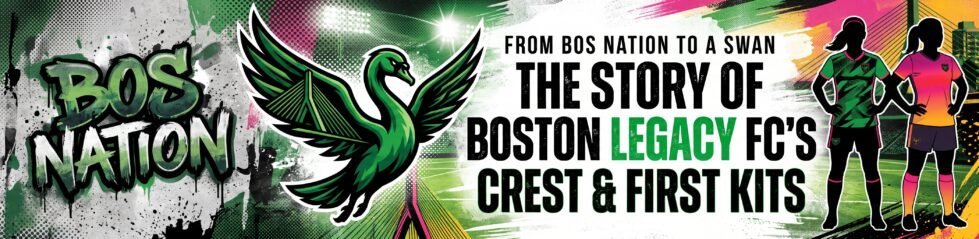
On Saturday, June 7, 2025, Boston Legacy FC threw a party on Boston Common and showed its crest to fans for the first time. It’s a white swan with raised wings on a black shield edged in green. The National Women’s Soccer League expansion club was still nine months from its first match, and it had already dropped one name, so the drawing had a lot of work to do.
The swan has now been through a full season. It went on two Nike kits, made its debut in front of 30,207 people at Gillette Stadium and saw out the year with a 4-1 loss at Angel City on November 1, 2026. Nearly every part of it points back to something in Boston, including a women’s club that folded eight years before this one kicked off.
BOS Nation, the name that lasted five months
The club first introduced itself on October 15, 2024, as BOS Nation FC. Its leaders said the name was an anagram of “Bostonian.” It’s pronounced “boss nation.” The same announcement set out the colors. The main one was Championship Green, which the club tied to the Boston Strong slogan, and it came with accents of red, black, pink, yellow and orange meant to represent the city’s neighborhoods.
The launch went wrong almost at once. Billboards and a video built around the slogan “Too Many Balls” drew heavy criticism, and the club apologized the next day and later removed the campaign posts. By late November it was asking supporters what they thought of the name itself.
On March 26, 2025, BOS Nation became Boston Legacy Football Club. ESPN reported that a survey of 1,500 fans and brand professionals had produced more than 500 name ideas and a shortlist of 14. Two of the club’s rules for the new name stand out. It had to “require no explanation,” which the anagram never managed, and it had to “steer clear of colonial, Revolutionary War, and nautical themes.” The club promised a crest and wordmark in the coming months.
Those banned themes cover a good deal of local precedent. The Patriots and the Revolution, who both play at Gillette Stadium, take their names from the Revolutionary War era. And the Breakers, Boston’s previous women’s pro soccer team, had a name that means breaking waves.
Why the designers chose a swan

Graphic designer Matthew Wolff led the crest project, and the club said it took five months. Controlling manager Jennifer Epstein explained the choice of bird in a statement released with the crest. Swans, she said, are “famously loyal” and “relentless in defending their territory.” The club’s own description has the swan in motion, wings raised, “equally prepared to attack and defend.”
Swans live on ponds and lagoons, so the bird kept the crest inside the club’s own rule against nautical themes, if only just. The club’s release placed the bird in the Emerald Necklace parks and the Boston Public Garden, which the club called the first public botanical garden in the United States.
Eight feathers for eight founding clubs
Count the swan’s feathers and you get eight. They stand for the eight teams that started the NWSL in 2013, and one of those was the Boston Breakers. The club also angled the feathers to follow the lines of the Zakim Bridge, the cable-stayed crossing that carries Interstate 93 over the Charles River.
The Breakers had a long life before the NWSL. The club was founded in 2000 for the Women’s United Soccer Association and played from 2001 until that league folded in 2003. The name came back in 2009 with Women’s Professional Soccer, which collapsed in 2012, and the team spent that year in the WPSL Elite before joining the new league. After a 4-13-7 season in 2017 and a sale that fell through, the NWSL announced on January 28, 2018, that the Breakers would cease operations. By The Equalizer’s count, no name in North American women’s professional soccer was older.
Boston then went eight seasons without a top-flight women’s soccer team. The feathers bring the Breakers into the new crest without reusing their name.
Three colors where there had been six
The finished crest uses green, black and white. According to the club’s crest announcement, the green stands for Boston’s parks, including Franklin Park, where White Stadium sits, and the club chose “a bold and bright shade” so the team would stand out. Black and white give the design its structure. The shield itself is a traditional soccer shape, drawn with sharper and more modern angles.
Compare that with October 2024, when the club listed a primary green and five accent colors. Cutting the count in half suits a crest that has to work on a phone screen and a shirt sleeve alike. It was the right call, even if the finished look is plainer than that first color list promised.
First Light and Common Ground, the 2026 kits
Nike made both shirts for the first season. The home kit, called First Light, was revealed in mid-February 2026. It’s Legacy Green with touches of Pitch Black, Stadium White and Fireberry, and the name refers to the club’s first season. The small detail worth looking for is the hem tag, a nod to the Franklin Park Zoo, which shares a park with the club’s planned home.
The secondary kit, Common Ground, launched on February 26 at the Cyclorama of the Boston Center for the Arts. It has a Pitch Black base with a collage of overlapping shapes based on the city’s neighborhoods, in Fuchsia Flash, Pitch Black and Legacy Green, with accents of Dynamic Yellow and Cone Orange. Nike used a repeated tile print to cut fabric waste, so the neighborhoods sit in slightly different places on every retail shirt. The name partly refers to Boston Common, where the crest had been unveiled less than nine months earlier.
Look at those accent names again. Pink, yellow and orange, the neighborhood colors from the BOS Nation launch, returned as Fuchsia Flash, Dynamic Yellow and Cone Orange, and on this shirt they once again stood for the neighborhoods. They just stayed off the crest.
Both shirts also carry the same three sponsor logos. T.J. Maxx, whose parent company is based in Framingham, signed a multi-year deal in October 2025 to put its name across the front. Voya Financial took the lower back in January 2026, and Hyundai followed in February with the right sleeve. Like the shirts, this history of the crest and kits has a sponsor, GamingToday, whose sweepstakes casino bonus guide reviews current no-deposit offers and explains how it checks each one.
The swan’s first season on the field
The crest made its competitive debut on March 14, 2026, at Gillette Stadium against Gotham FC, the 2025 champions. The crowd of 30,207 was, at the time, an NWSL record for an expansion club’s home opener; Denver later broke it. Esther González scored in the 55th minute, and Gotham won 1-0.
Boston lost its first five matches. The first win came on May 3 against Denver Summit FC, the league’s other 2026 expansion side. Bianca St-Georges scored in the fourth minute of stoppage time to finish a 3-2 comeback in front of 12,524 at Gillette, as the club’s match report recorded. The Legacy also beat Portland, Washington and Kansas City, but a winless August ended any playoff push, and elimination came in late September.
Home games were split between Gillette and Centreville Bank Stadium, the 10,500-seat ground in Pawtucket, Rhode Island, built for Rhode Island FC. Across the two venues, the Legacy averaged 10,809 fans.
Still waiting for Franklin Park
The crest’s green was picked partly for Franklin Park, and the club still hasn’t played a match there. The Massachusetts Supreme Judicial Court cleared the White Stadium renovation on August 19, 2026, but a schedule review that followed found the stadium wouldn’t be ready for the start of the 2027 season. The Legacy will play their 2027 home games in Pawtucket and move to White Stadium in 2028. By then the crest will be heading into its third season. When the club finally gets there, it will play in the same park as the zoo that inspired the hem tag on its first home shirt.